Apollo Summit 2026: Turn Your API Platform Into Your AI Platform

Eric Holzhauer
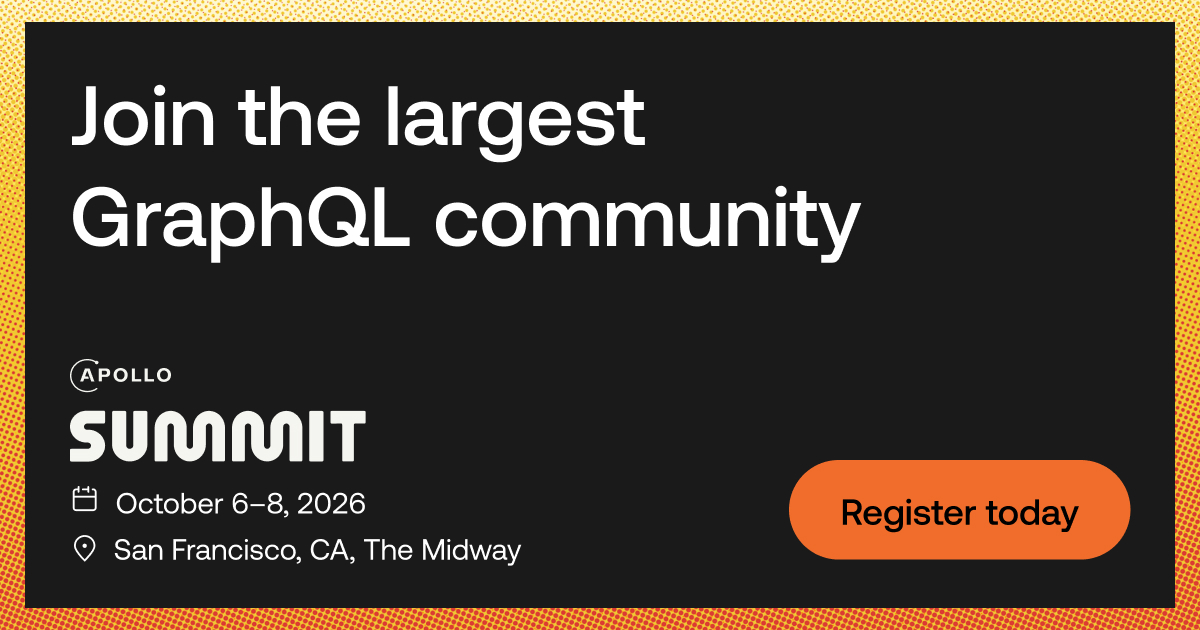
Apollo’s annual conference, and the world’s largest GraphQL event, returns to San Francisco in October. Apollo Summit 2026 runs October 6 to 8, 2026, at The Midway, with sessions and workshops on how a well-governed graph turns into the entry point for agents and applications alike.
Apollo has always worked on the difficult middle layer between backend systems and the clients that need to access them, from the early Meteor days through GraphQL’s origins as a way to fetch data for web and mobile apps, and now as the layer that connects AI agents to the systems they need to access in order to do real work. If you own a GraphQL implementation, or you are weighing how your API strategy fits into your AI roadmap, this is where the practical patterns get worked out in public.
Meet the Speakers
Your APIs were built for apps. What happens when agents want in? These five speakers have already shipped an answer, and they’ll show their work. Stay tuned for more speakers to be announced soon.
- Jonathan Wondrusch, Staff Software Engineer at Block, argues your company already has a graph, hiding in Confluence pages and a hundred half-documented REST endpoints. He shows how to build an API schema that ships product to customers and becomes the context layer your agents reason against. The surprise is that it makes the business legible to itself.
- Clarice Abreu, Senior Software Engineer at Brex, opened GraphOS and found 35% of their federated graph was dead code. Rather than spend months cleaning 60+ subgraphs by hand, she built an agent that deletes, validates, and opens the PR. It has removed over 100,000 lines, and not one customer noticed.
- Gijs Martens, Platform Engineer, and Bart van Lakwijk, Manager Web Platform at Coolblue, routed all production traffic through their graph in week one. The cutover was the easy part. Winning over a “just do it” business meant treating the graph as a utility, not a religion, and never blocking a team. No mandate. The graph sold itself.
- Sharon Gorla, Lead Engineer at Starbucks, has a rule for what survives a rewrite: business semantics and shared contracts, never implementation patterns. As coding agents rebuild whole systems, the gap people miss isn’t MCP or agent frameworks. It’s alignment. Clients come and go. Shared nouns and verbs are the durable layer.
Why this matters now
Organizations are often pulled in opposing directions: deploying agents quickly vs. keeping control over what they can do. Teams that move fast often hand agents broad access and lose visibility. Teams that lock things down slow every project to a crawl. Summit 2026 is built around a different premise: speed and control are not a tradeoff when the graph sits between your agents and your systems.
A self-describing graph gives agents declared, scoped access to exactly the tools they need and nothing more. It reduces token costs by handing agents the right context for each action, enforces field-level security, and improves success rates by making your existing APIs discoverable. The sessions show how teams are already doing this in production.
What you’ll learn
The agenda is organized around four themes that map to the decisions facing platform and AI teams right now.
- Agent infrastructure. Design the governed entry point between agents and enterprise systems. Build a context layer that improves task success rates while keeping costs down.
- Governance and security. Manage agent identity, start from zero-rights defaults, enforce field-level access policies, and handle credentials in a single layer. Give both developers and non-developers a trusted platform to build on.
- Agentic API access. Connect REST APIs, SQL data sources, MCP servers, and third-party systems into your context layer, whether or not they already live in your graph.
- GraphQL and GraphOS. For teams running GraphQL in production today: the latest in Apollo Federation, Apollo Router optimization, schema governance, Apollo Connectors, and the Apollo MCP Server.
Who you’ll meet
Summit draws platform engineers, AI infrastructure leads, developers, and technical leaders who are building API infrastructure for both applications and agents. It is also where the broader GraphQL community gathers, including the people who maintain the specifications and tools the industry runs on. You will leave with patterns you can apply and a set of peers solving the same problems.
What to expect
The format balances learning and doing. Expect keynotes, customer talks, hands-on technical workshops, and time to meet the experts and ask your questions. You can hear about how some of the fastest-moving companies are building agents, learn architectural patterns to apply in your own API strategy, and try it out in a workshop, all in just a few days.
Here is the shape of the conference:
- Tuesday, October 6. Arrivals, registration, and a welcome reception from 5 to 7pm.
- Wednesday, October 7. Sessions and an evening event, 9am to 9pm.
- Thursday, October 8. Sessions and departures, 9am to 3pm.
Pricing and registration
Registration is now open. Get your Summit pass for $399, including breakfast, lunch, and unlimited coffee and snacks across the event. Dietary preferences selectable at sign-up.
October 6 to 8, 2026 at The Midway, San Francisco.


